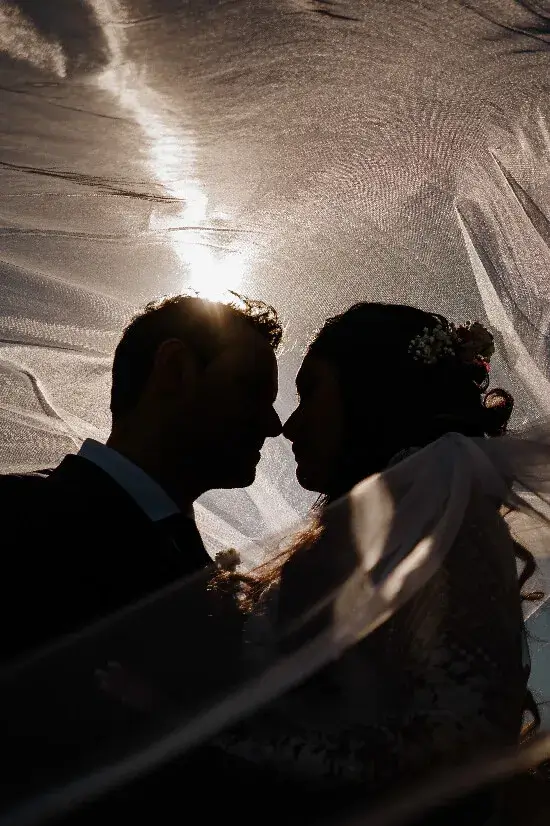
A doorway can do more than tell us where a portrait happened. A curtain can do more than decorate a room. Placed carefully inside the photograph, either can create a second frame that directs attention toward a face, a gesture or the space between two people.
Frame within a frame wedding photography works best when that extra shape has a purpose. Before looking for a clever opening, decide what deserves attention. Otherwise you may produce an excellent photograph of a doorway with a couple somewhere inside it.
Start with what the frame reveals
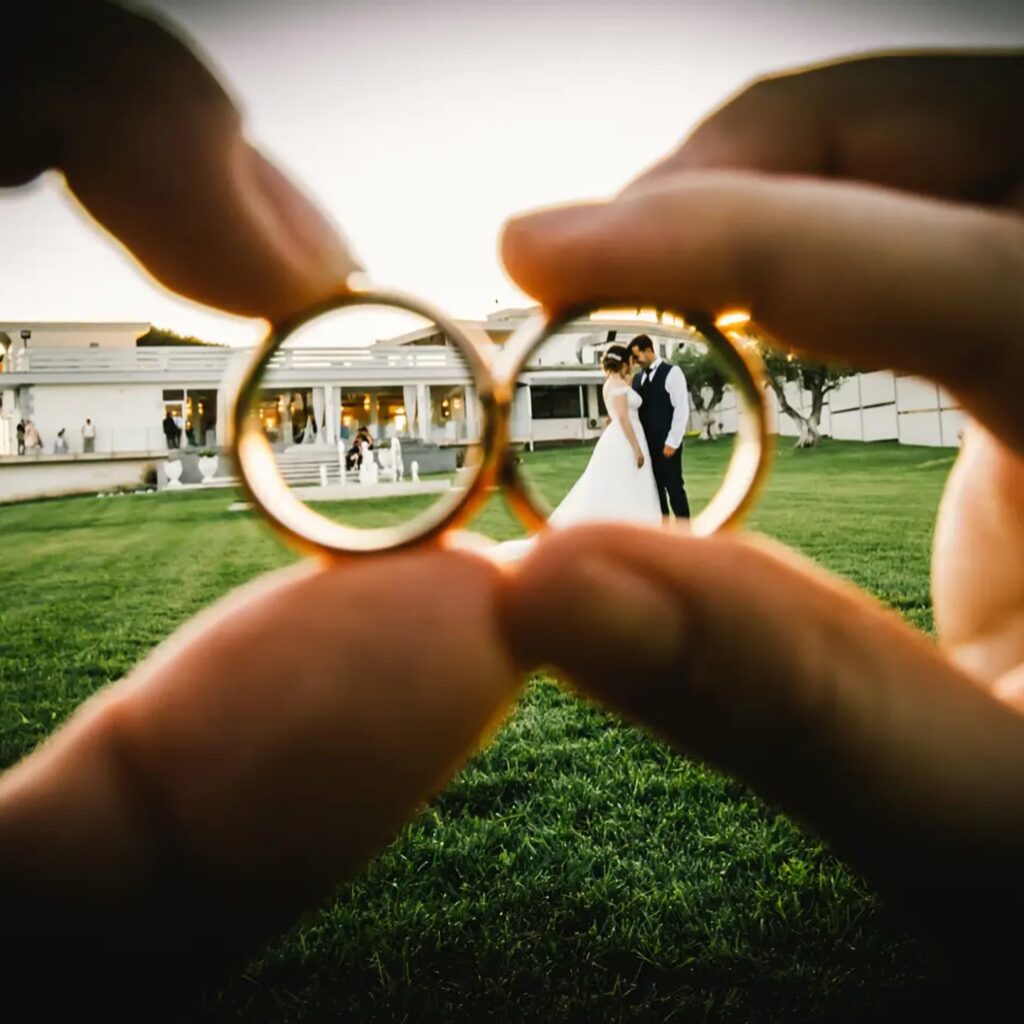
In Biagio Sollazzi’s portrait, wedding rings held near the camera become a small opening around the distant couple. The foreground detail and the people are connected by meaning as well as placement. The frame earns its place because it gives us a reason to look through it.
Decide which details must remain legible before introducing a foreground object. Check faces, hands and the edges of the opening. A small change in the camera position can turn an awkward obstruction into a clear relationship. These are exercises inspired by the visible result, not a reconstruction of the photographer’s method.
Move your camera before you move the couple
Once the people are comfortable, shift a little left or right and compare the edges. Does a doorframe cut across a face? Does a bright strip lead the eye out of the picture? Is one person disappearing behind the foreground? Small changes in camera position can alter these overlaps without restarting the pose.
Keep your footing and the working space clear. You do not need to squeeze into a hazardous position to make a frame look unusual. If an opening is awkward, find another angle or abandon it. The couple should never have to negotiate a balancing exercise for the composition.
Let the setting contribute more than a rectangle
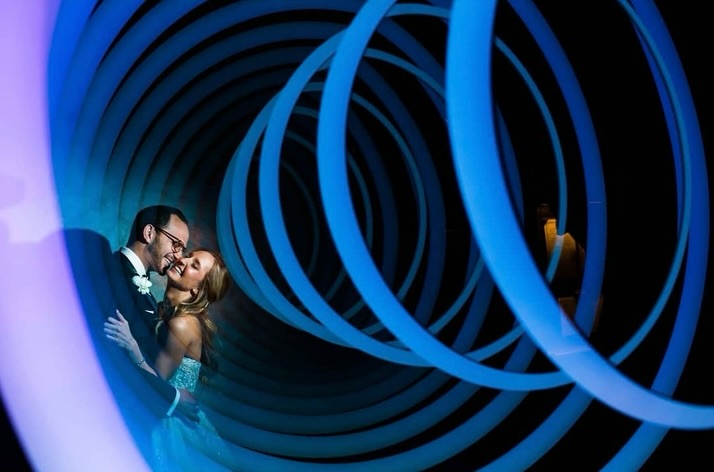
In The Madious’ portrait, overlapping blue circles wrap around the couple and carry the eye through successive layers. A frame does not have to resemble a window. Curves, repeated shapes and a small change of viewpoint can turn part of the setting into a path toward the people.
Look for this relationship in your own location: an arch plus a curved path, a door plus a line of light, or a curtain plus a visible gesture. Nikon’s composition guide explains how straight and curved lines can direct attention. Applied here, the question is whether those lines return us to the people or carry us away from them.
Control the visual weight of the foreground
A dark frame can make a bright face feel prominent; a bright foreground can compete with it. Check both the edges and the subject in the image review. If the frame attracts attention first and keeps it, simplify the scene or change your position. More foreground is not automatically more depth.
You can also compare a clearly defined frame with a softer one. Focus on the intended subject and review the result at a useful magnification, especially when both faces need to be sharp. Choose your aperture for the people and the intended depth, rather than using the widest available setting out of habit.
Find a frame in the people around you
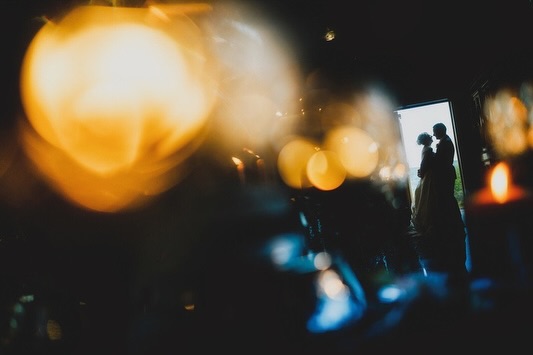
A frame does not need to be architectural. In Giorgos Kouzilos’s reception photograph, guests in the foreground leave an opening around the bride. The overlapping figures create depth while the strings of lights connect the celebration behind them. The picture feels close to the action because the photographer is looking through the gathering.
At a reception, look for brief gaps between people without blocking anyone’s view or interrupting the dance. Watch the central expression and the edges together: a face visible one moment can disappear behind a shoulder the next. Keep observing rather than arranging guests into a frame.

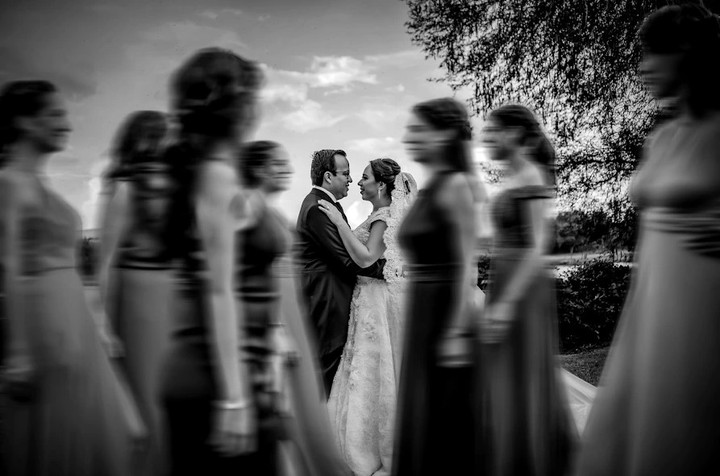
Lux Hunters use passing guests as a soft foreground around the couple. Their bodies create an opening without becoming a rigid border. Wait for a clear gap, keep the people you want to show readable and let the surrounding movement tell us that the celebration continues beyond the portrait.
Try the three-frame exercise
During a practice session, make three photographs from one comfortable setup: a clean portrait with no foreground obstruction, a version with a visible frame, and a wider image showing the room. Compare what each one communicates. Keep the framed version only if it adds intimacy, context or a stronger path toward the subject.
The same test applies when editing a wedding gallery. A few framed portraits can create variety; a whole sequence of hidden faces can become repetitive. Mix close, clear pictures with more layered compositions. For another way to build foreground depth, explore our guide to creative veil photographs. Let the technique support the people, then know when to step out from behind it.